<strong>Chapo.
Night after night the Moon seems unchanging, yet its slow retreat from Earth is quietly rewriting the rhythm of our planet.
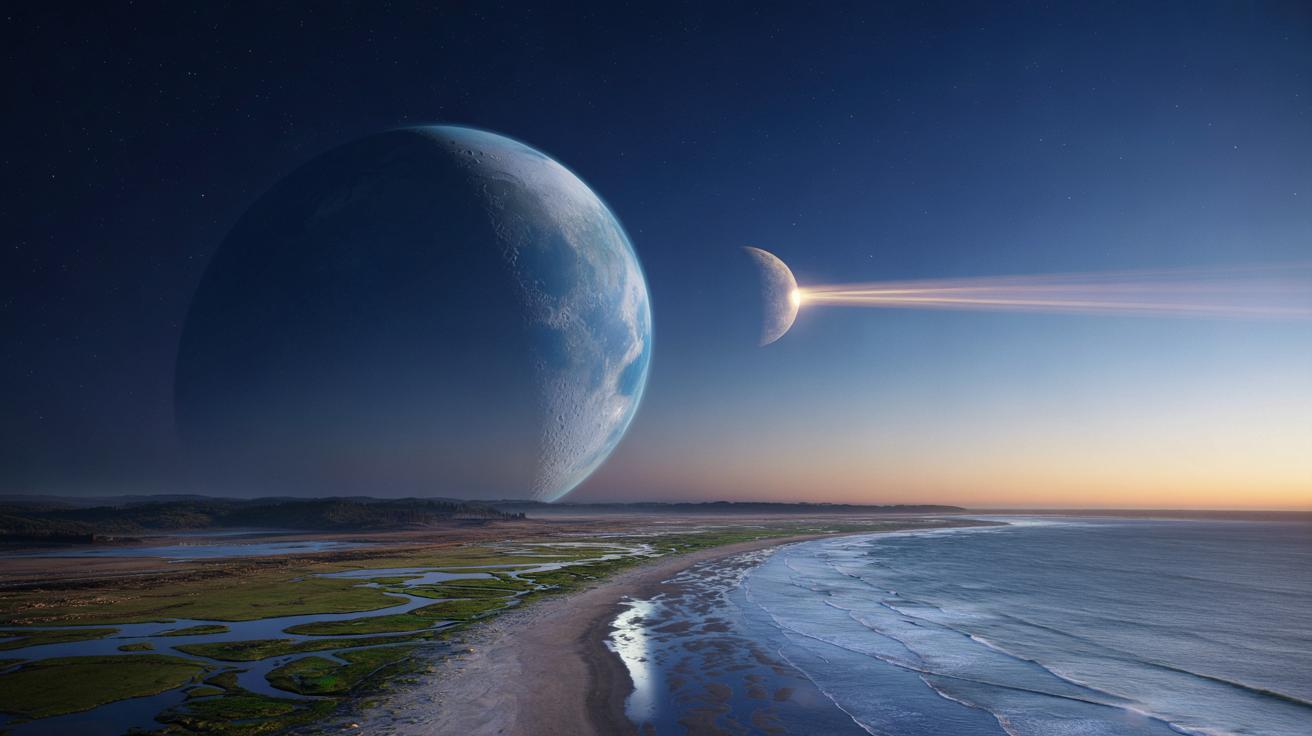
Hidden behind familiar moonrise scenes, a deep celestial reshuffling is underway. The Moon is edging farther from Earth every year, stretching our days, reshaping our tides and, over vast timescales, altering the face of life on our planet.
How a drifting Moon stretches Earth’s days
The Moon does not simply circle Earth like a clockwork toy. The two bodies trade energy through gravity, especially through tides. That exchange leaves measurable fingerprints on the length of the day.
Today, a full rotation of Earth takes about 24 hours. In the age of the dinosaurs, it was shorter. Studies of fossil seashells from about 70 million years ago show that a year then contained roughly 372 days. That means each day lasted around 23.5 hours.
Those ancient molluscs grew in daily layers, a bit like tree rings. Under a microscope, the bands act as a time log. Counting them reveals how many days fitted into a year of virtually unchanged length, set by Earth’s orbit around the Sun. More days per year can only mean shorter days.
The farther the Moon drifts from Earth, the longer our days become, gaining milliseconds every century.
This is not just a curiosity for palaeontologists. It shows that the Earth–Moon partnership has been evolving since early in the planet’s history. When the Moon first formed, probably after a colossal collision more than 4 billion years ago, it orbited much closer. From Earth’s surface it would have loomed huge in the sky, and its pull on the oceans would have been ferocious.
Why tides are the engine of the Moon’s escape
The root of the Moon’s slow escape lies in the tides rolling around our planet. As Earth spins, the Moon’s gravity drags the oceans into two bulges: one facing the Moon, one on the opposite side. Because Earth rotates faster than the Moon orbits, those bulges are not perfectly aligned with the Moon.
The tidal bulge is dragged slightly ahead of the Moon’s position. That offset matters. Gravity between the bulge and the Moon acts like a gentle forward tug on the Moon, giving it a tiny boost of speed in its orbit. A faster orbit at the same time means the Moon moves outward.
Laser measurements from Apollo reflectors show the Moon is retreating by about 3.8 centimetres every year.
➡️ What if the key to fighting Alzheimer’s wasn’t in the brain, but in the muscles?
➡️ Caffeine Becomes A Molecular Switch Envisioned For Treatment
➡️ Abandoned in adulthood, this habit could quietly extend your wellbeing
➡️ Unexpected find: thousands of nests spotted beneath Antarctic ice
➡️ An Oat-Based Diet Cuts Cholesterol In Just Two Days
➡️ Gut microbiome and daily flatulence: unexpected numbers
➡️ The “brain‑eating” amoeba shrugs off chlorine and slips into our water systems
➡️ Because of our lifestyle, osteoarthritis is surging among young adults worldwide
That energy must come from somewhere: Earth’s rotation. As the Moon gains orbital energy, Earth loses rotational energy, and its spin slows down. The result is a day that lengthens very slightly with time. The change is tiny on human scales, but over millions of years it adds up.
- Energy flows from Earth’s rotation into the Moon’s orbit.
- Tides, offset by Earth’s spin, provide the “gravitational brake”.
- Slower rotation means longer days for future generations.
What changing tides mean for the oceans
The Moon is the main driver of tides, with the Sun adding a secondary effect. As the Moon moves away, its grip on our seas weakens. Tide heights slowly shrink. Strong tidal ranges, such as those seen in the Bay of Fundy or the Severn Estuary, depend on the balance between Moon, ocean depth and coastline shape.
Over long spans of time, ocean basins themselves rearrange through plate tectonics. Coastlines shift, seafloors rise and sink, and new bays open. The changing lunar distance layers another slow trend onto this restless geography.
Future Earth will likely see calmer tides, with reduced ranges that reshape coastal ecosystems and sediment flows.
Many coastal wetlands, salt marshes and estuaries rely on regular tidal flooding. Tiny adjustments in water level can decide whether certain plants thrive or disappear. Fish and birds that time their migrations to specific tidal conditions may face gradual but unavoidable pressure to adapt.
Eclipses fading from total to partial
The Moon’s shrinking apparent size in our sky has another striking consequence: solar eclipses. At present, the Moon can perfectly cover the Sun from our viewpoint, giving dramatic total eclipses. As the Moon recedes, it will appear smaller, like a coin held further from the eye.
At some point in the distant future, the Moon will no longer fully cover the Sun. Eclipses will still happen, yet they will mostly be annular, with a thin ring of sunlight glowing around the Moon’s silhouette. For any future civilisation, the spectacular total eclipse will be a thing of the geological past.
Could Earth and Moon ever “lock” together?
The Moon always shows the same face to Earth because it is “tidally locked”. Friction inside the Moon, caused by Earth’s gravity, long ago synchronised its rotation with its orbit. The same process is nudging Earth in that direction, but far more slowly.
If nothing interrupted this dance, Earth would eventually rotate so slowly that one day would match one lunar month. In that case, one hemisphere of Earth would always see the same face of the Moon, just as the Moon always shows us one side now. Tides would settle into a much more static pattern.
| Stage | Earth’s day length | Tidal behaviour |
|---|---|---|
| Age of dinosaurs | ~23.5 hours | Stronger, faster tides |
| Present day | 24 hours | Dynamic, familiar tides |
| Far future (theoretical) | Much longer than 24 hours | Weaker, slower tides |
Reality may cut that story short. Stellar models suggest that in around a billion years, increasing solar energy will likely strip away Earth’s oceans. Without vast bodies of liquid water, classical tides almost vanish, and the main driver of the Moon’s outward drift disappears.
How scientists track such tiny changes
Measuring a 3.8-centimetre yearly drift across 384,000 kilometres of space sounds daunting. The key tool is lunar laser ranging. Apollo astronauts left mirrored panels on the Moon’s surface. On Earth, observatories fire short laser pulses at those reflectors and time their return.
Since light travels at a fixed speed, the round-trip time gives the distance to the Moon with millimetre precision. Repeating the measurements over decades reveals how the distance slowly grows. Combined with ancient records locked into rocks and fossils, researchers can reconstruct Earth’s rotational history across deep time.
From fossil seashells to Apollo mirrors, multiple lines of evidence point to the same story: a slowing Earth and a receding Moon.
What this means for people living on coasts
For modern coastal communities, the Moon’s retreat is not a pressing threat. Climate change, sea level rise and storm surges are far more immediate concerns. The yearly change in tides due to the receding Moon is too tiny to notice without instruments.
Yet over geological intervals it affects how sediment is moved, how deltas grow, and how coastlines evolve. When planners consider very long-lived structures such as major sea barriers or new ports, the slow drift of tidal patterns enters into some high-end modelling, alongside tectonic and climatic trends.
Key terms that help make sense of the story
Several technical phrases often appear in discussions of the Earth–Moon system, and they shape how scientists think about our future:
- Tidal friction: Heat and energy loss created as tides flow against the seafloor and coastlines, acting like a brake on Earth’s rotation.
- Angular momentum: A measure of rotational motion. In the Earth–Moon pair, total angular momentum is shared, so as Earth slows, the Moon’s orbit gains.
- Tidal locking: A state where one body always shows the same face to another, as the Moon already does to Earth.
Thinking about these concepts helps frame not just the Moon’s behaviour, but also the odd rotations of many exoplanets and moons discovered around distant stars.
Imagining Earth hundreds of millions of years from now
Run the clock forward and a very different Earth emerges. Days lengthen by minutes, not just milliseconds. Tides become gentler. Continents drift into new configurations, and mountain ranges rise where today there are oceans.
If any future life watches the sky, it will see a smaller Moon and mostly ring-shaped solar eclipses. The familiar rhythm of today’s tides will belong to the distant geological past. The slow-motion separation of Earth and Moon shows that even what seems steady and eternal — a 24-hour day, the regular rise and fall of the sea — is only a temporary arrangement in a restless cosmos.