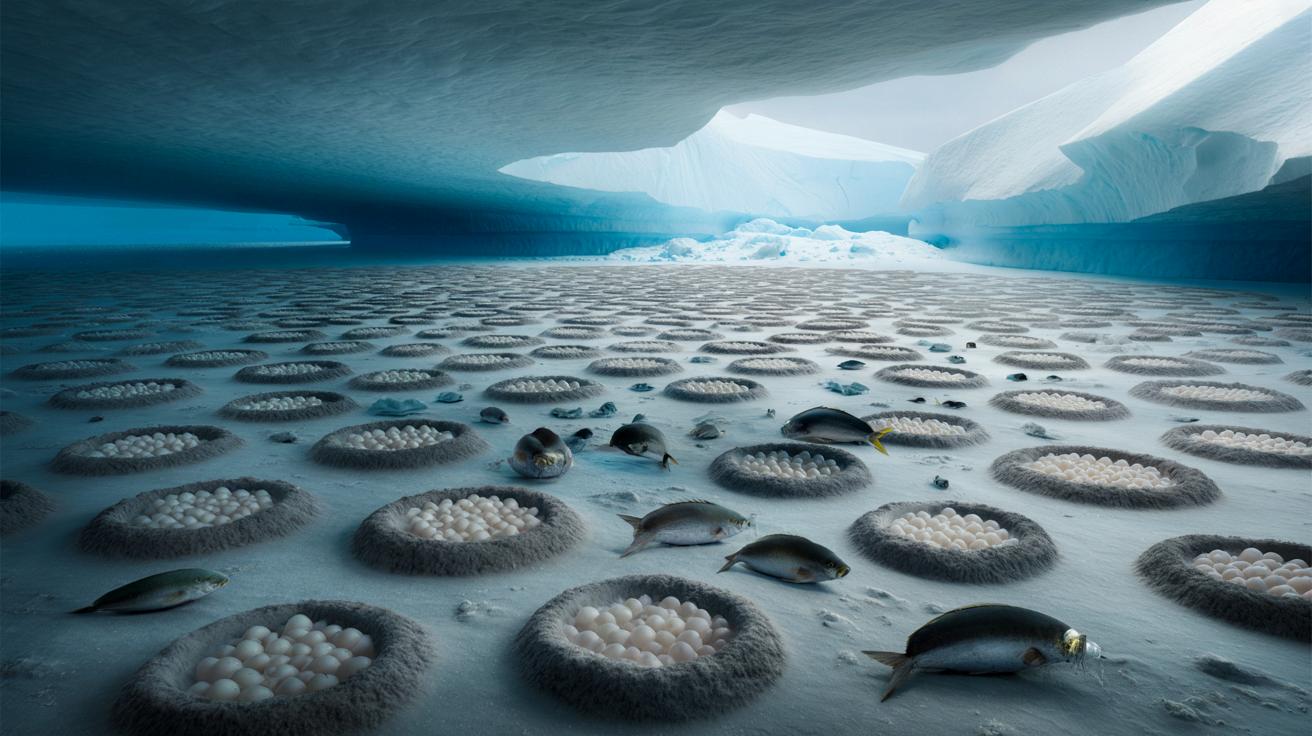
Far below the Antarctic pack ice, in waters once thought almost lifeless, cameras have caught something strangely ordered.
Researchers searching for a century‑old shipwreck instead stumbled on a hidden underwater landscape: thousands of carefully shaped fish nests stretching across the seafloor in neat patterns beneath the ice.
Under the ice, a long-hidden landscape of life
The story begins in the Weddell Sea, a remote, ice-choked corner of Antarctica that few ships ever reach. For decades, thick sea ice kept its seabed completely out of sight. Oceanographers had assumed that such cold, dark waters supported only sparse life, scattered and simple.
That idea started to crumble in 2017, when the giant iceberg A68 broke away from the Larsen C ice shelf. The break-up suddenly opened a window onto about 5,800 square kilometres of previously sealed ocean. For marine biologists, it was a rare chance: here was seafloor that had been shielded from sunlight and human disturbance for centuries.
A later expedition, the Weddell Sea Expedition 2019 aboard the research vessel SA Agulhas II, went south with a different primary goal. The team wanted to locate the wreck of the Endurance, Ernest Shackleton’s legendary ship that sank in 1915. But alongside the search operations, the crew deployed a remotely operated vehicle nicknamed “Lassie” to scout the seabed.
What Lassie sent back to the ship stunned everyone. Across large areas of the otherwise flat, debris-covered seafloor were circular clearings: shallow depressions in the sediment, clean and sharply edged, while everything around them was draped in a blanket of organic detritus.
Instead of a barren polar desert, the cameras revealed a vast grid of carefully maintained nests, each one guarded by a fish.
Some depressions appeared alone, others formed lines, arcs or tight clusters. After counting and mapping the images, scientists realised they were looking at thousands of fish nests, organised in a way that looked closer to a planned neighbourhood than random scatter.
Meet the Antarctic nest-builders
The architects of this underwater suburbia are Lindbergichthys nudifrons, a small Antarctic rockfish adapted to frigid waters that hover around freezing. These fish, usually overlooked in field guides, now sit at the centre of one of the most striking polar biology findings of the decade.
Each nest holds a clutch of eggs, and each nest has a dedicated adult standing guard. Using fins and body, the parent fish clears the sediment, removing debris and keeping the egg mass exposed and well-ventilated. The adult then stays, often motionless but alert, defending the spot from predators and scavengers.
➡️ As the Moon Gradually Drifts Away From Earth, Our Days And Tides Quietly Change
➡️ Caffeine Becomes A Molecular Switch Envisioned For Treatment
➡️ The “brain‑eating” amoeba shrugs off chlorine and slips into our water systems
➡️ Gut microbiome and daily flatulence: unexpected numbers
➡️ Because of our lifestyle, osteoarthritis is surging among young adults worldwide
➡️ Loose eyelid syndrome can reveal a hidden sleep disorder
➡️ Abandoned in adulthood, this habit could quietly extend your wellbeing
➡️ An Oat-Based Diet Cuts Cholesterol In Just Two Days
This level of parental care is already noteworthy in such harsh conditions. What truly caught researchers off guard was the social geometry of the nesting grounds.
Six nest patterns, one shared strategy
By analysing video and sonar data, scientists identified at least six distinct ways the nests were arranged on the seafloor:
- Solitary nests, standing alone
- Crescent-shaped groups of nests
- Oval clusters
- Nests lined up in almost straight rows
- U-shaped formations with open “entrances”
- Dense clusters where nests nearly touch
This wasn’t random packing. The patterns suggest that the fish adjust their positions with other nests in mind, not just the physical environment. Studies referenced by the team indicate that temperature, light and sediment type cannot fully explain the layout. Instead, social interactions shape the colony.
The nesting field behaves like a living city, where neighbours provide protection and spacing is a collective decision, not just a coincidence.
Biologists link this structure to what’s known as the “selfish herd” effect. Individuals in the middle of a group benefit because predators are more likely to hit someone at the edge first. In dense nest clusters, central eggs and adults gain an extra buffer from those at the perimeter.
That may help explain why the toughest or most competitive fish often occupy solitary nests on the outskirts: they gain more space and fewer neighbours to compete with, but must fend off threats alone. The arrangement reflects a trade-off between solitude and safety that has rarely been documented in polar fishes.
Why such complexity matters in polar waters
This colonial nesting ground challenges the long-standing view of Antarctic benthic life as simple and thinly spread. Comparable behaviour—large-scale, structured nesting colonies—is well known from some tropical reef fish. Seeing it repeated in the icy Weddell Sea suggests that social complexity is less tied to warm, rich waters than many textbooks imply.
It also reshapes how ecologists think about productivity at high latitudes. The nests sit within a food web that reaches from microscopic algae living in and under the ice, through plankton, up to fish, seals and whales. If such nesting fields are common in the Southern Ocean, they could play a larger role in sustaining predators than previously recognised.
| Aspect | Tropical reef fish colonies | Antarctic Lindbergichthys nests |
|---|---|---|
| Water temperature | Warm, stable | Near freezing, highly seasonal |
| Nest organisation | Clusters, territories, sometimes complex | Large-scale patterns: rows, crescents, U-shapes |
| Main threats | Reef predators, storms, human activity | Predators, changing ice conditions, future fishing |
| Research history | Extensively studied for decades | Only recently documented at scale |
A vulnerable ecosystem at the edge of change
The nesting area identified in the Weddell Sea fits the definition of a vulnerable marine ecosystem. It hosts a unique biological structure, tied to a specific part of the seafloor, and could be easily damaged by disturbance. Deep trawling, mineral prospecting or unregulated fishing would not just remove fish. They would flatten entire nesting neighbourhoods that may take years to recover, if at all.
International bodies have already discussed giving the Weddell Sea stronger protection as a marine protected area. The images of guarded nests provide a powerful argument: this is not an empty, icy backwater but a finely tuned habitat that underpins local biodiversity.
Protecting these nest fields means safeguarding a crucial link in the Antarctic food chain, from plankton under the ice to seals at the surface.
Pressure is growing as climate change redraws the physical map of the region. As ice shelves break up and sea ice patterns shift, new zones will open to fishing fleets and scientific traffic. Without clear rules, activity could surge before scientists even finish taking stock of what lives there.
What “vulnerable marine ecosystem” actually means
In policy language, a vulnerable marine ecosystem (VME) is not just any nice patch of nature. It describes a seafloor habitat that meets several criteria, such as being rare, structurally complex, functionally important for many species, and easily damaged by human gear.
The Weddell Sea nesting ground ticks multiple boxes. It is structurally complex, thanks to the dense, repeated nest architecture. It supports a key life stage—reproduction—for a polar fish species. And it is highly sensitive: a single pass from heavy fishing gear could erase both nests and eggs across wide swathes.
Recognising an area as a VME can trigger stricter rules for bottom fishing and industrial activities. For the Weddell Sea, that could mean bans on certain gear types, limited access zones, or seasonal restrictions tied to breeding periods.
What might happen next on the Antarctic seafloor
Scientists now face a race against time and ice. Future surveys will likely return to the same sites once sea ice conditions allow, to check whether the same spots are reused year after year or if the colonies shift across the seabed. Tagging individual fish could reveal how they choose their nesting locations and neighbours.
There is also interest in modelling how these colonies respond to warming waters. Even a small temperature increase can alter plankton blooms, oxygen levels and predator ranges. Simulations suggest that if predators such as starfish or certain fish species gain easier access, the benefits of clustering might change, forcing Lindbergichthys to rearrange their patterns or face higher egg losses.
For readers curious about practical implications, this kind of research feeds into better fisheries management. If a commercial fishery one day targets species sharing habitat with these nest builders, maps of nest fields could guide no-take zones to avoid spawning sites, similar to how cod or grouper spawning grounds are protected in other oceans.
The Antarctic nests also provide an accessible example for understanding broader ecological ideas, such as the selfish herd effect or the balance between cooperation and competition. Schools can use this case in lessons on animal behaviour, showing how simple rules—stay close to neighbours, defend your spot—scale up into intricate patterns seen from a robot’s camera hundreds of metres below the ice.